After the end of World War I, Armenia emerged landlocked and largely isolated, having fought alone against vastly superior forces, yet counted among the victors and recognized as an ally of the Entente. However, in late 1918 and early 1919, an economic blockade imposed by neighboring states led to a severe food crisis with catastrophic consequences, claiming the lives of approximately 180,000 people in Armenia. Despite this tragedy, the Armenian people did not lose hope, believing in the possibility of a free and peaceful future and the eventual return to their homes. Beginning in late 1918, Turkish forces started to withdraw from Armenian territories, including Alexandropol (Gyumri), Nakhijevan, Sharur, and Zangezur, and in April 1919, Armenian forces entered Kars, which became part of Armenia. From early 1919, Armenian refugees—especially nearly 100,000 Armenians who had fled the Kars region due to Turkish invasion—sought to return. Within a few months, despite immense difficulties, the Armenian government, with the assistance of British local authorities, managed to organize the repatriation of nearly 50,000 Armenian refugees who had fled to the North Caucasus in 1918. This repatriation process was interrupted in July 1919 as economic hardship and internal instability, including Muslim uprisings, further worsened the situation.
— Dr. Smbat Minasyan
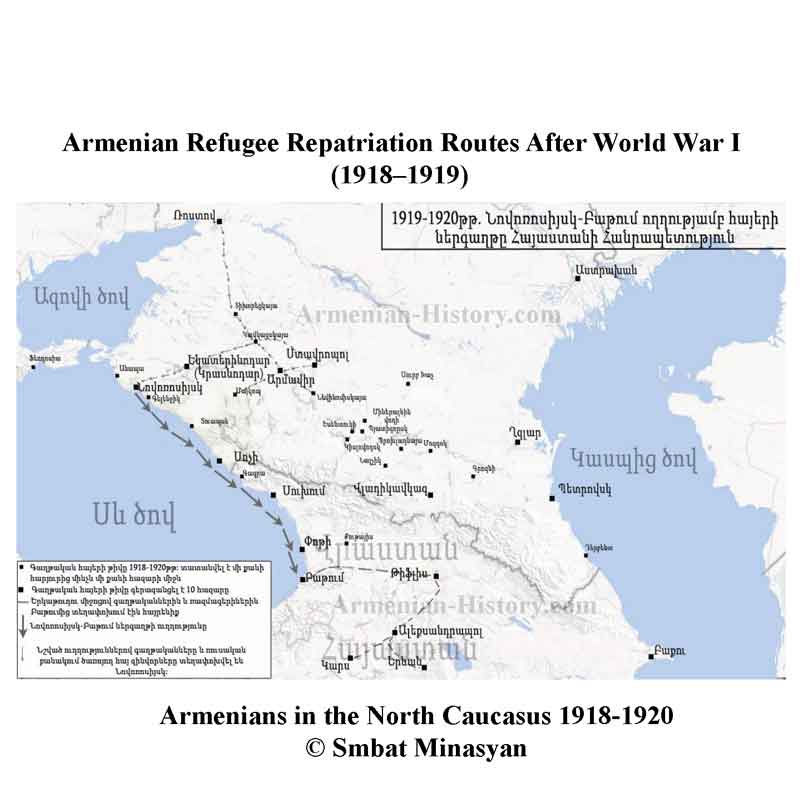
This topic is explored in greater detail in Armenians in the North Caucasus (1918–1920) by Dr. Smbat Minasyan, which examines the displacement, survival, and repatriation of Armenian refugees during the turbulent postwar years through archival research and original maps.