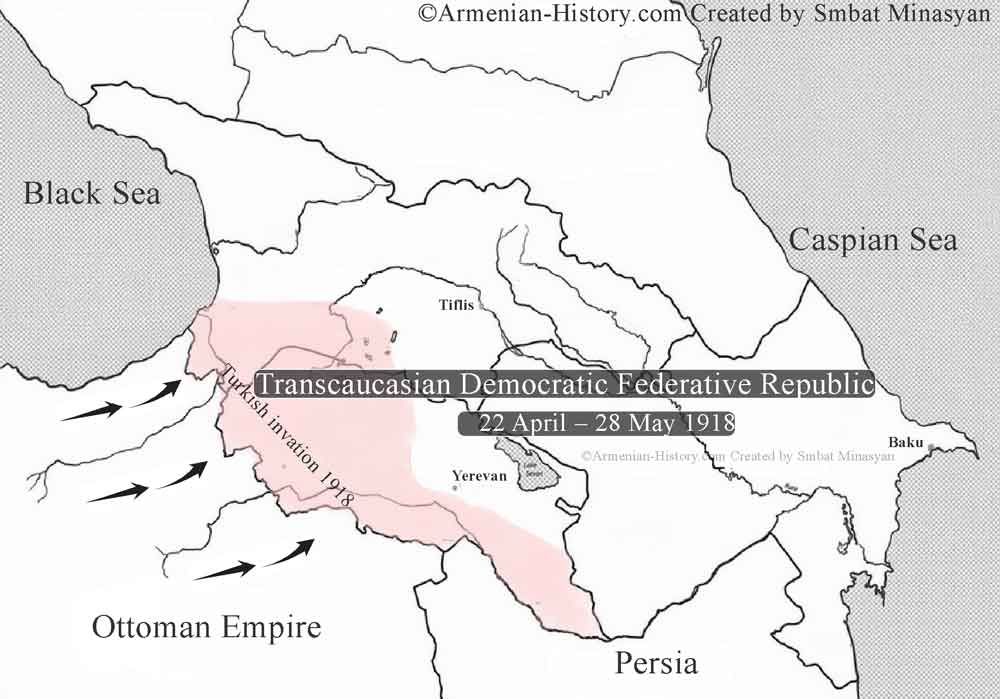
The Transcaucasian Democratic Federative Republic (TDFR) was a short-lived political entity that existed from 22 April to 28 May 1918 in the South Caucasus. Formed in the aftermath of the Russian Revolution and the collapse of the Caucasus Front, it united the territories of present-day Armenia, Georgia, and Azerbaijan under a single federal structure.
Although its lifespan lasted barely five weeks, the federation represents a critical transitional moment between imperial rule and the emergence of independent nation-states in the region.
Historical Background
Following the February and October Revolutions of 1917 in Russia, imperial authority in the Caucasus effectively collapsed. The Russian army disintegrated, leaving the region militarily exposed. Local political leaders from Armenian, Georgian, and Azerbaijani communities initially attempted to preserve stability through the Transcaucasian Commissariat and later the Transcaucasian Sejm (parliament), headquartered in Tiflis (Tbilisi).
The situation was complicated by the Treaty of Brest-Litovsk (3 March 1918), through which Soviet Russia ceded Kars, Ardahan, and Batum to the Ottoman Empire. Ottoman forces subsequently advanced eastward, placing additional pressure on the newly formed political structure in the Caucasus.
Amid this military and political crisis, the Transcaucasian Democratic Federative Republic was proclaimed on 22 April 1918.
Structure and Internal Tensions
The federation included representatives of three major political forces:
- Armenian parties (notably the Armenian Revolutionary Federation)
- Georgian Mensheviks
- Azerbaijani Musavat representatives
While the idea of a unified Caucasian federation appeared practical under external threat, internal divisions quickly surfaced. The three national groups differed in:
- Foreign policy orientation
- Military strategy
- Attitudes toward negotiations with the Ottoman Empire
- Long-term visions of sovereignty
These differences proved difficult to reconcile, particularly as Ottoman military advances continued.
Ottoman Advance and Military Pressure
By the spring of 1918, Ottoman forces had already occupied territories ceded under Brest-Litovsk and continued advancing into Transcaucasian lands.
The federation faced immediate existential pressure. In May 1918, major battles were fought in Armenian-populated areas, including the Battle of Sardarapat, Bash Abaran, and Karakilisa. These engagements were decisive in halting further Ottoman advance toward Yerevan.
The military crisis exposed the fragility of the federal structure.
Dissolution of the Federation
On 26 May 1918, Georgia declared independence.
Two days later, on 28 May 1918, Armenia and Azerbaijan also proclaimed independent republics.
With these declarations, the Transcaucasian Democratic Federative Republic ceased to exist.
Its collapse was not merely the result of internal disagreement, but also the product of wartime conditions, divergent diplomatic strategies, and the absence of a unified military command.
Historical Significance
Although short-lived, the TDFR occupies an important place in the political history of the South Caucasus:
- It marked the final attempt at a unified post-imperial Transcaucasian state.
- It served as the immediate precursor to the First Republic of Armenia (1918–1920), the Democratic Republic of Georgia, and the Azerbaijan Democratic Republic.
- It revealed both the possibility and limits of regional federalism under conditions of war and imperial collapse.
The federation’s brief existence highlights the complex political landscape of 1918 — a moment when new states were emerging under extreme pressure, shifting alliances, and uncertain international recognition.