
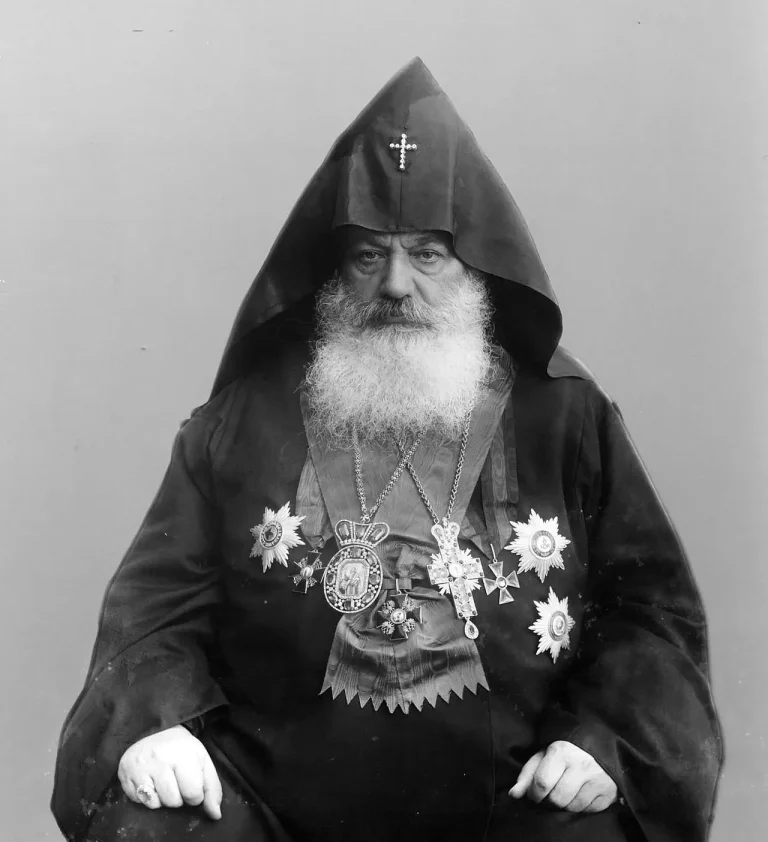
Gevorg V was the spiritual leader of the Armenian Apostolic Church during one of the most difficult and decisive periods in Armenian history. Serving as Catholicos during World War I, the Armenian Genocide, and the battles of May 1918, Gevorg V became an important religious and national figure at a time when Armenians faced war, displacement, famine, and the threat of destruction in Eastern Armenia.
His leadership during the Battle of Sardarapat and the establishment of the First Republic of Armenia connected the Armenian Church closely with the Armenian national struggle for survival and independence.
Early Life and Religious Education
Gevorg V was born in 1847 as Gevorg Sureni Khachatryan in Artsakh (Karabakh), then part of the Russian Empire. From a young age, he became connected with the Armenian Church and pursued religious education within the Armenian ecclesiastical system.
He studied at the Gevorgian Seminary of Etchmiadzin, one of the most important theological and educational centers of the Armenian Apostolic Church. During his years of study, he gained deep knowledge of Armenian theology, church traditions, religious literature, and ecclesiastical administration.
After completing his education, he entered the clergy and gradually advanced through different church positions due to his discipline, education, and leadership abilities. Before becoming Catholicos, he served in several important ecclesiastical and administrative roles within the Armenian Church.
Becoming Catholicos of All Armenians
In 1911, Gevorg V was elected Catholicos of All Armenians and became the spiritual leader of the Armenian Apostolic Church at the Mother See of Etchmiadzin Cathedral.
At that time, the Catholicos held enormous importance not only as a religious authority, but also as a national figure for Armenians living across the Russian Empire, the Ottoman Empire, and other regions. During centuries without independent Armenian statehood, the Armenian Church remained one of the central institutions preserving Armenian identity, education, manuscripts, traditions, and community life.
Gevorg V’s years as Catholicos coincided with major political and military upheavals that transformed the entire region.
Gevorg V During World War I and the Armenian Genocide
The years of Gevorg V’s leadership overlapped with some of the darkest events in Armenian history. During World War I and the Armenian Genocide, Armenians across the Ottoman Empire faced deportation, massacres, starvation, and displacement.
The Armenian Church became deeply involved in humanitarian efforts, refugee support, and the preservation of Armenian religious and cultural institutions. Large numbers of Armenian refugees eventually reached Eastern Armenia, placing enormous pressure on the already unstable region.
During this period, Gevorg V also appealed to international powers and Christian organizations regarding the suffering of Armenians and the humanitarian catastrophe affecting the Armenian population.
Gevorg V and the Battle of Sardarapat
In May 1918, Ottoman forces advanced toward Yerevan and Etchmiadzin after the collapse of the Caucasus Front. The remaining Armenian-populated territories in Eastern Armenia faced possible destruction, while thousands of refugees continued arriving after the Armenian Genocide.
During these critical days, Gevorg V became one of the important spiritual and symbolic leaders of Armenian resistance. He supported Armenian defensive efforts and refused proposals to relocate the Catholicosate from Etchmiadzin to a safer location despite the approaching Ottoman Army.
Historical accounts describe how Gevorg V called upon Armenians to defend their homeland and sacred sites during the critical days of May 1918. According to his famous appeal:
“If the Armenian people cannot stop the advance of the enemy, if they are unable to save our sanctuaries, then I myself will take a sword and fall in the courtyard of the Mother Cathedral, but I will not leave the Holy See, which was left as a deposit by our grandfathers.”
His decision to remain at Etchmiadzin became one of the symbolic moments of Armenian resistance during the Battle of Sardarapat.
At the same time, Armenian military commanders, volunteers, clergy, political leaders, and ordinary civilians organized resistance against the Ottoman advance. The Armenian victories at Sardarapat, Bash Abaran, and Karakilisa prevented the collapse of Eastern Armenia and helped preserve the territory that later became the foundation of the independent Armenian state.
The First Republic of Armenia
Only days after the Armenian victories of May 1918, Armenians declared the independence of the First Republic of Armenia on May 28, 1918.
Gevorg V became the presiding Catholicos during the establishment of the First Republic of Armenia, linking the Armenian Church closely with the restoration of Armenian statehood after centuries of foreign rule.
During the short existence of the republic, Armenia faced enormous challenges, including refugee crises, famine, epidemics, economic collapse, and regional conflicts. Throughout this difficult period, the Armenian Church continued serving an important spiritual and national role.
Later Years and Death
After the Sovietization of Armenia in 1920, the Armenian Church entered a much more difficult period under Soviet anti-religious policies. Religious institutions increasingly faced pressure, restrictions, and political control.
Gevorg V continued serving as Catholicos during the early Soviet years until his death in 1930.