History of Kars – Medieval Capital of Armenia
Kars, located approximately 50 kilometers northwest of the ruins of Ani, was one of the important political and military centers of medieval Armenia. Situated in the historical Armenian district of Vanand, the city rose to particular prominence under the Bagratuni dynasty in the 10th century, when it became a royal capital and later the center of a separate Armenian kingdom.
Over the following centuries, Kars passed through the control of numerous states and dynasties. Its strategic position near major routes connecting the Armenian Highlands, the Caucasus, and Anatolia made it both an important regional center and a frequent object of military competition.

Kars as a Capital of Bagratid Armenia
Kars became especially important during the reign of King Abas I Bagratuni, who ruled Armenia from 928/929 to 953. Abas established his royal residence at Kars, strengthened the city, and made it the political center of the Bagratid kingdom.
One of the most important surviving monuments associated with his reign is the Cathedral of Kars, commonly known today as the Cathedral or Church of the Holy Apostles. Constructed between approximately 930 and 942, it is one of the most significant surviving examples of 10th-century Armenian architecture.
Kars continued to serve as the Bagratid capital after Abas’s death. In 961, his successor Ashot III the Merciful transferred the royal capital from Kars to Ani, which was developing into the principal political, economic, and cultural center of Bagratid Armenia.
The transfer did not end the political importance of Kars. Ashot III appointed his younger brother Mushegh Bagratuni to govern the city and the surrounding region of Vanand. In 963, Mushegh proclaimed himself king. Ashot III recognized the new kingdom on the condition that it acknowledge the supremacy of the senior Bagratuni monarchy centered at Ani. Armenian historical scholarship therefore treats the Kingdom of Kars, or Vanand, as one of the Armenian kingdoms that developed within the broader Bagratuni political system.
The Armenian Kingdom of Kars
The Kingdom of Kars existed from 963 until 1065 and was ruled by a branch of the Bagratuni dynasty. Mushegh was succeeded by his son Abas and later by Gagik-Abas, the last king of Kars.
Although governed by its own monarchs, the kingdom maintained close political and dynastic relations with Ani and recognized the senior position of the main Bagratuni line. After the Byzantine annexation of the Kingdom of Ani in 1045, the ruler of Kars became the senior surviving representative of the Bagratuni royal house.
The regional balance of power changed dramatically with the expansion of the Seljuk Turks. After the Seljuk capture of Ani in 1064, Gagik-Abas sought to preserve his kingdom but ultimately ceded Kars to the Byzantine Empire in 1065, receiving estates farther west in return. Byzantine control proved short-lived, and Kars soon passed into the expanding Seljuk sphere.
The Kingdom of Kars had therefore survived for more than a century and had outlasted the central Bagratuni kingdom at Ani by approximately two decades.
Kars from the Medieval Period to Ottoman Rule

During the following centuries, control of Kars changed repeatedly as the political landscape of the Armenian Highlands and the South Caucasus was transformed.
In the early 13th century, Georgian-Armenian forces associated with the expansion of the Georgian kingdom and the Zakarian Armenian princes gained control of Kars and other parts of northeastern historical Armenia. This period ended with the Mongol invasions of the 13th century. The region subsequently passed through the hands of different Mongol and Turkmen political formations.
The Ottoman Empire eventually incorporated Kars into its eastern frontier system during the 16th century. Because of its location near the border with Safavid Persia, the city acquired considerable military importance. In 1579, the Ottomans undertook a major reconstruction of the fortress and defensive works, strengthening Kars as an important eastern stronghold.
For much of the following period, the city’s political and military significance was shaped by rivalry among the Ottoman, Persian, and later Russian empires.
Kars under Russian Rule

(painter January Suchodolski)
Russian expansion into the South Caucasus brought Kars increasingly into the struggle between the Russian and Ottoman empires.
Russian forces temporarily captured Kars during the Russo-Turkish War of 1828–1829 and again during the Crimean War in 1855, but on both occasions the city was returned to Ottoman control as part of subsequent peace settlements.
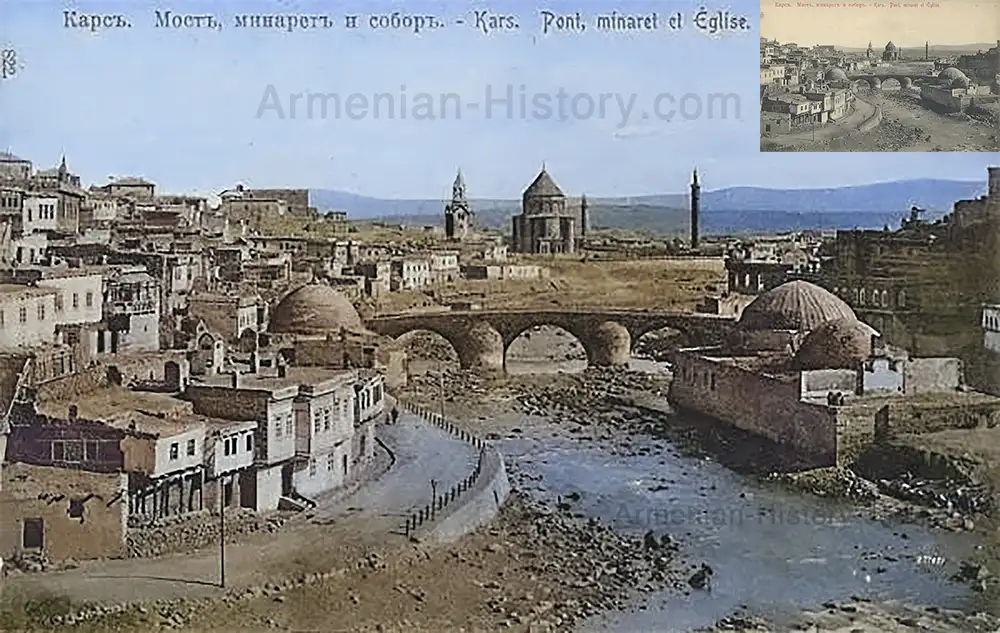
The decisive change came during the Russo-Turkish War of 1877–1878, when Russian forces captured Kars once again. Following the war, Kars and the surrounding region became part of the Russian Empire. The city became the administrative center of the newly organized Kars Oblast, one of the empire’s southwestern frontier regions.
The decades of Russian administration substantially transformed the city. A new district with broad streets and stone buildings was developed south of the older fortress city, giving parts of Kars the distinctive late-19th-century urban appearance visible in historical photographs.
The city’s population also changed considerably. Many Muslims left the territories incorporated into the Russian Empire after the war, while Armenians, Greeks, Russians, and other populations moved into Kars and the surrounding region. Armenians arrived both from other parts of the Russian-controlled Caucasus and from the Ottoman Empire.
According to the 1897 Russian Imperial census, Kars had a population of 20,805, including 10,332 Armenian speakers, representing approximately 49.7 percent of the city’s population. Russians, Greeks, Poles, Tatars, Turks, and other communities also formed part of Kars’s increasingly diverse urban population.
By the beginning of the 20th century, Kars had developed into an important Armenian urban, commercial, religious, and cultural center.
The Cathedral of Kars
Among the city’s most important Armenian monuments was the cathedral built during the reign of King Abas I in the 10th century. Today commonly known as the Church of the Holy Apostles, the building was originally constructed between approximately 930 and 942. Interestingly, medieval Armenian authors generally referred to it simply as the cathedral; the name “Holy Apostles” is first documented much later.

The building survived repeated political changes, although its function and appearance were altered several times.
Following the Russian capture of Kars in 1877, it was converted for use as a Russian Orthodox church. Porticoes, a sacristy, and an ornate iconostasis were added during this period. These additions help explain why the cathedral appears somewhat different in late-19th-century photographs from what the original 10th-century structure would have looked like.
Despite centuries of conversion, alteration, and reuse, the core of King Abas’s 10th-century Armenian cathedral has survived. The building currently functions as a mosque.
Kars during World War I
Kars again became strategically important during World War I. The Ottoman military considered its recovery one of the major objectives of the Caucasus campaign. The Ottoman offensive toward the region in the winter of 1914–1915 culminated in the catastrophic Ottoman defeat at the Battle of Sarikamish.
Russian forces subsequently advanced deep into Ottoman territory, but the Russian Revolution of 1917 caused the rapid disintegration of the Caucasus Front. Armenian military units were increasingly left to defend a vast front after the withdrawal of Russian forces.

The Treaty of Brest-Litovsk, signed on March 3, 1918, provided for the withdrawal of Russian forces from Kars, Ardahan, and Batum. Ottoman forces continued their advance and captured Kars on April 25, 1918. This occurred more than a month before the establishment of the Republic of Armenia on May 28, 1918, an important chronological distinction that is sometimes overlooked.
Following the Ottoman defeat in World War I and the Armistice of Mudros in October 1918, Ottoman forces were required to withdraw from much of the South Caucasus.

Kars and the First Republic of Armenia
The political situation in Kars remained unsettled during the winter of 1918–1919. A local administration known as the South-West Caucasian government operated in the region while British forces attempted to manage the political transition following the Ottoman withdrawal.

In April 1919, British authorities dissolved this administration. On April 19, 1919, the province was formally handed over to Armenian governor Stepan Korganian, as British authorities moved to place Kars under the administration of the First Republic of Armenia pending a broader international settlement. Armenian military and civil institutions subsequently established effective control over the city and much of the province.
Kars therefore became one of the strategically most important territories administered by the First Republic. Its fortress, railway connections, agricultural resources, and geographic position made control of the region particularly significant for the security of Armenia’s western frontier.
The Armenian administration of Kars, however, lasted only until the following year.
The Fall of Kars in 1920

In September 1920, war broke out between the First Republic of Armenia and the Turkish National Movement led by Mustafa Kemal. Turkish forces on the eastern front were commanded by Kâzım Karabekir.
After Armenian defenses deteriorated during the campaign, Turkish forces captured Kars on October 30, 1920. The loss of the heavily fortified city was a decisive military setback for the Armenian Republic and was followed shortly afterward by the loss of Alexandropol.
At the same time, Soviet pressure on Armenia was intensifying from the east and north. The combined military and political crisis led to the collapse of the First Republic at the beginning of December 1920 and the establishment of Soviet power in Armenia.
The Armenian population of Kars was largely displaced during the fighting and its aftermath. The large Armenian community that had developed in the city during the late 19th and early 20th centuries effectively disappeared.
The Treaty of Kars
The territorial settlement that followed was formalized the following year.
On October 13, 1921, representatives of the Government of the Grand National Assembly of Turkey and the Soviet republics of Armenia, Azerbaijan, and Georgia, with the participation of Soviet Russia, signed the Treaty of Kars. The treaty confirmed the new frontier and placed Kars, Ardahan, and the Surmalu district—including Iğdır—within Turkey.
It is important to distinguish the actual provisions of the treaty from later interpretations. The treaty did not contain a provision ordering the deportation of Armenians. Article 13 stated that inhabitants of former Russian territories recognized as Turkish could relinquish Turkish nationality, leave Turkey, and take their possessions or the proceeds from their sale.
By the time the treaty was signed, however, war, displacement, and the political transformations of 1918–1921 had already fundamentally changed the demographic character of Kars. The Armenian community that had once formed a major part of the city’s population no longer remained there in significant numbers.
The Armenian Historical Legacy of Kars
The history of Kars reflects several major periods of Armenian history. It was a capital of Bagratid Armenia, the center of the Kingdom of Kars or Vanand, an important medieval Armenian religious and architectural center, a major Armenian-populated city under Russian rule, and for a brief period in 1919–1920 part of the First Republic of Armenia.
The surviving 10th-century cathedral, the medieval urban landscape, historical photographs, maps, and archival documents continue to preserve evidence of this long Armenian presence.
Kars also illustrates the repeated political transformations experienced by the Armenian Highlands: the rise and fragmentation of medieval Armenian kingdoms, Byzantine and Seljuk expansion, Mongol invasions, Ottoman-Persian and Ottoman-Russian rivalry, the collapse of empires during World War I, and the brief restoration of independent Armenian statehood in the early 20th century.
For Armenian history, Kars is therefore significant not simply as a lost city or former territory, but as a place closely connected with medieval Armenian statehood, architecture, urban life, and the political history of the First Republic of Armenia.